Written By: Kaneez Fatma
Produced By: Bella Fusion
Format: Cinematic Sufi Muqabla (Vocal Debate)
Introduction
Since the earliest expressions of Sufi thought, the human heart has been understood as a field of tension between two loves:
- Ishq-e-Majaazi — love directed toward the created, transient, and form-bound
- Ishq-e-Haqeeqi — love directed toward the Creator, the Eternal, the Formless
“Ishq-e-Haqeeqi vs Ishq-e-Majaazi (The Muqabla)” presents this tension as a dramatic, musical dialogue. The composition traces a movement from attachment and illusion, through rupture and insight, to surrender and unity.
The Lore: The Battle of Two Loves
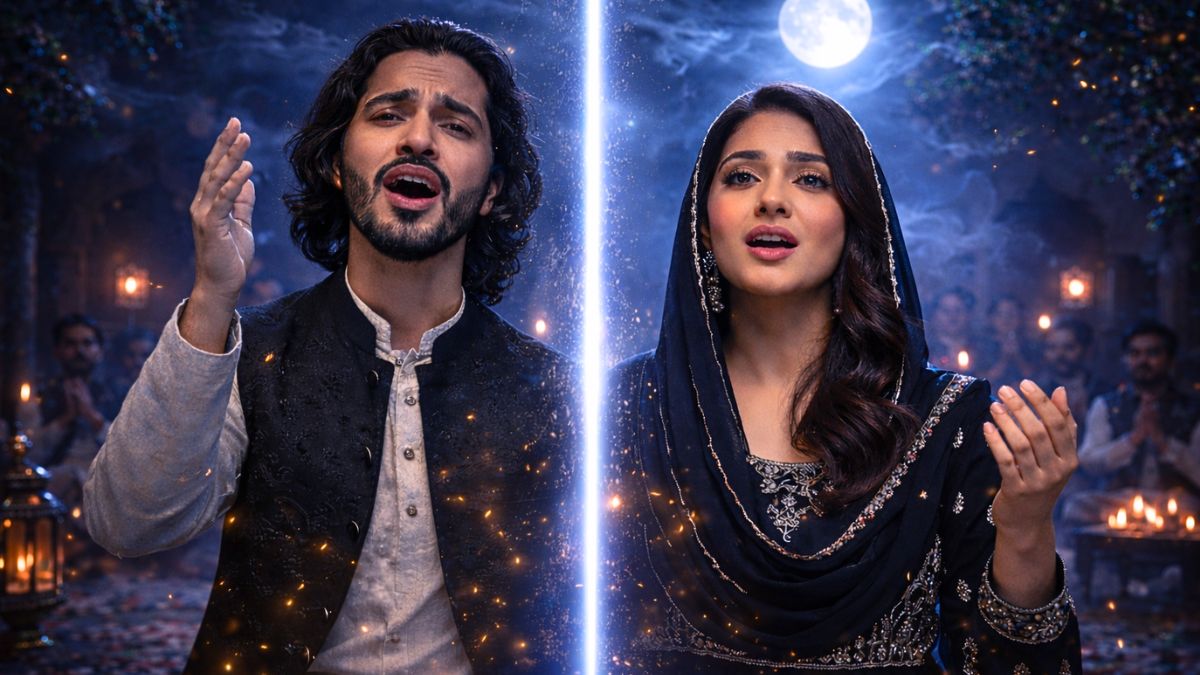
This Muqabla stages a conversation between two inner voices:
Female Voice — The Heart (Ishq-e-Majaazi)
The feminine voice represents the experiencing heart—intense, devoted, and vulnerable. It is captivated by beauty and presence, and it absolutizes what is, in reality, contingent. Its error is not love itself, but misplacement of the Absolute within the finite.
Male Voice — The Soul / Murshid (Ishq-e-Haqeeqi)
The masculine voice functions as the awakening principle—the Murshid, or inner guide. It does not negate love; it purifies and reorients it. It distinguishes between the reflection (aks) and the Source (asl), between the perishing and the abiding.
Phase 1: The Illusion of Love (Prelude & Mukhda)
Female Lead
मैंने यार को ही अपना जहाँ मान लिया,
हर दर्द को उसकी अदा मान लिया!
उसकी एक झलक पे मैं क़ुर्बान हूँ,
मैंने इश्क़ में ख़ुद को फ़ना मान लिया!
Meaning
The speaker declares a total existential investment in the beloved. In Sufi vocabulary, she invokes fanā—the annihilation of the self—but applies it to a mortal object.
This is the subtle error of Ishq-e-Majaazi:
the structure of devotion is correct, but its orientation is misplaced.
She sacralizes even pain, interpreting it as “ada” (grace). This reflects the Sufi intuition that suffering can be meaningful—but here, meaning is still tied to the finite beloved, not the Divine.
Male Response
तूने ख़ाक के पुतले को सज़दा किया,
एक फ़ानी बशर पे भरोसा किया!
ये हुस्न तो ढल जाएगा…
जिसको रहबर समझा… वही राह भटक जाएगा…
तूने कच्चे धागे को आसरा मान लिया!
Meaning
The response introduces ontological clarity:
- Khāk (dust) signifies the material, perishable nature of creation
- Fānī bashar emphasizes impermanence
- Kachha dhāga (fragile thread) symbolizes unstable reliance
The critique is not of love itself, but of granting ultimacy to what is contingent.
Beauty fades, promises fracture, and even guides may err—because all that is created remains within becoming and decay.
Phase 2: The Clash and the Mirror (Reflection vs Reality)
Female Argument
उसकी आँखों में मुझे एक नूर दिखता है…
उसके आगे ये ज़माना बेनूर दिखता है…
क्या हुस्न से इश्क़ करना कोई जुरम है मौला?
Meaning
Here the heart articulates a profound intuition: it perceives Noor (Divine Light) in the beloved.
This reflects a genuine Sufi principle:
the Divine manifests through forms.
Her question—“Is it a sin to love beauty?”—touches a classical Sufi paradox:
Can love for the visible become a bridge to the Invisible?
Male Response
अक्स को तूने हक़ीक़त समझ लिया…
एक क़तरे को समंदर समझ लिया…
नूर उसका है… ये चेहरा तो बस ख़ाक है…
ये इश्क़ नहीं… बस एक फ़रेब है!
Meaning
The Murshid clarifies the metaphysics of perception:
- The beloved is an aks (reflection)
- The light belongs to the Source, not the mirror
To mistake the mirror for the source is to confuse tajalli (manifestation) with Zaat (Essence).
The metaphor of qatra (drop) and samandar (ocean) indicates a scale error:
the finite cannot contain the Infinite.
Thus, the problem is not seeing light—but misidentifying its origin.
Phase 3: Heartbreak as Divine Intervention
Female (Broken)
क्यों इश्क़ ने दी है मुझे इतनी रुसवाई…
उसकी यादें मुझे सोने नहीं देतीं…
Meaning
The collapse of worldly attachment manifests as:
- Restlessness
- Insomnia
- Emotional fragmentation
This is the shattering of the constructed self—the nafs losing its object of fixation.
Male (Revelation)
जब टूटता है दिल इंसाँ का… तो ख़ुदा याद आता है!
ये ठोकर नहीं… उसकी तरफ़ बुलावा है!
वो तोड़ता है बुत तेरे दिल के… ताकि वो दिल में बस जाए…
Meaning
This is the philosophical center of the composition.
- But (idol) = anything that occupies the heart in place of the Divine
- The breaking of the idol is an act of Divine mercy, not cruelty
In Sufi understanding, the heart cannot host two absolutes.
Therefore, what is false must be removed so that the Real (al-Haqq) may be realized.
Thus, heartbreak becomes دعوت (invitation) rather than punishment.
Phase 4: Jugalbandi (Dialectic of Illusion and Truth)
Female: ये इश्क़-ए-मिज़ाजी है
Male: ये दर्द की बाज़ी है
Female: वो मेरा सनम है
Male: वो तेरा भरम है
Female: मेरा दिल टूट गया
Male: तेरा रब मिल गया
Sufi Meaning (Detailed)
This rapid exchange dramatizes the inner dialectic:
- The heart clings to form
- The soul exposes its instability
The decisive line—
“मेरा दिल टूट गया / तेरा रब मिल गया”—
reframes destruction as disclosure.
What appears as loss is, in Sufi terms, kashf (unveiling).
Phase 5: Realization and Return
Female (Awakening)
सच कहता है तू… ये दुनिया फ़ानी है…
टूट गया मेरा ग़ुरूर…
दिखा दे मुझे भी वो हक़ीक़ी नूर…
Sufi Meaning (Detailed)
The ego (ghurūr) collapses, and with it the illusion of permanence.
This moment corresponds to tawbah (turning/returning)—not merely repentance, but a reorientation of the entire being toward the Real.
The request for Haqeeqi Noor indicates readiness for directed, conscious seeking.
Wajd (Spiritual Ecstasy and Unity)
हक़ मौला! हक़ मौला!
तू ही तू! बस तू ही तू!
अल-मदद! अल-मदद!
दमादम मस्त क़लंदर!
Meaning
Wajd represents a state in which:
- Duality dissolves
- The distinction between seeker and sought becomes attenuated
The repetition of “Tu hi Tu” signifies the collapse of multiplicity into Unity (Tawheed).
This is not intellectual realization, but experiential absorption.
The Outro: Final Surrender
Female: अब सिर्फ़ तेरी तलब है
Male: बस तू ही मेरा रब है
Meaning
Desire (talab) is now purified.
It no longer seeks form, validation, or possession—only the Divine Presence.
The journey completes its arc:
- From attachment → to detachment
- From illusion → to discernment
- From multiplicity → to unity
The Central Sufi Principle
सूफ़ी कहते हैं:
इश्क़-ए-मजाज़ी ही इश्क़-ए-हक़ीक़ी का दरवाज़ा है
Interpretation (Sufi Perspective):
Worldly love is not rejected; it is transcended.
It functions as:
- An initiation into longing
- A training of the heart
- A mirror that, when correctly understood, points beyond itself
Thus, Ishq-e-Majaazi is not the destination, but the threshold.
Final Reflection
This Muqabla is not external.
It unfolds within every human being:
- Between attachment and transcendence
- Between perception and reality
- Between the self and the Source
The question remains:
Is love binding you to the finite…
or guiding you toward the Infinite?
Frequently Asked Questions (FAQs)
Q1: What is the meaning of Ishq-e-Haqeeqi vs Ishq-e-Majaazi?
Ishq-e-Majaazi refers to worldly love directed toward a human being, while Ishq-e-Haqeeqi refers to divine love directed toward the Creator. In Sufi philosophy, worldly love is often seen as a stepping stone that can guide a person toward divine realization.
Q2: Is Ishq-e-Majaazi wrong in Islam or Sufism?
No, Ishq-e-Majaazi is not considered wrong. Sufi teachings explain that it is a natural human experience. However, it becomes meaningful only when it leads beyond attachment and helps one recognize the deeper reality of Ishq-e-Haqeeqi.
Q3: What does “इश्क़-ए-मजाज़ी ही इश्क़-ए-हक़ीक़ी का दरवाज़ा है” mean?
This means that worldly love can act as a doorway to divine love. Through emotional attachment, longing, and even heartbreak, a person may begin to seek something more eternal, leading them toward spiritual awakening.
Q4: What is the concept of Wajd in Sufi Qawwali?
Wajd is a spiritual state of ecstasy where the seeker becomes deeply absorbed in divine remembrance. In Qawwali, it is often expressed through intense repetition, rhythm, and emotional surrender.
Q5: What is the main message of this Qawwali?
The central message is that love, even in its worldly form, is not meaningless. It is a journey that, when understood correctly, can transform into divine love and lead to a deeper connection with the Creator.
Q6: Who are the male and female voices representing in this Muqabla?
The female voice represents the emotional human heart attached to worldly love, while the male voice represents the awakened soul or spiritual guide (Murshid) guiding toward divine truth.